December 4, 2025 | Shana McAlexander

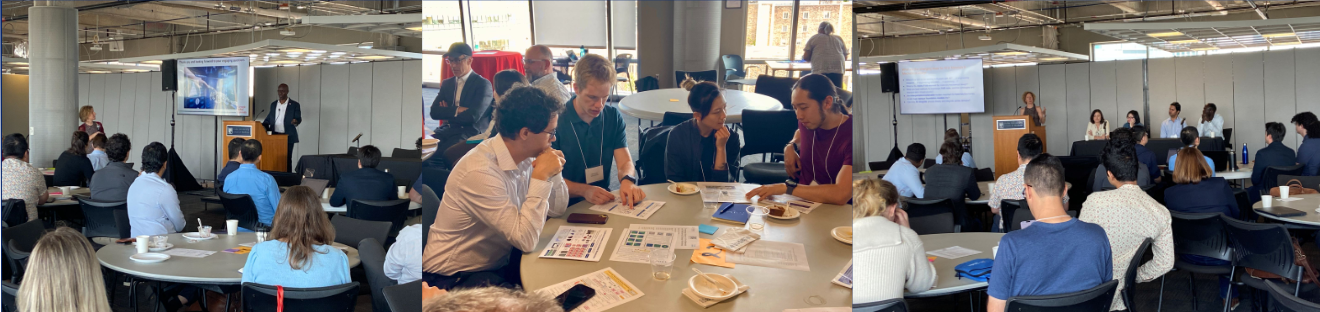
Duke's Thomas Lord Department of Mechanical Engineering and Material Science and the aiM program hosted a multi-institution workshop on Duke campus Emerging Ideas in AI for Materials and Mechanical Design on May 19-20, 2025. The event included keynotes, focal panels, a “collaboration cafe”, and research discussions where student, staff, and faculty researchers showcased the impact and breadth of their integrated education in AI and materials.
A key takeaway of the event was collaboratively defining the vision for advances in materials/mechanical design via AI/ML and to build community and new collaborations between leading researchers at all levels. The team generated the following list of their vision for Emerging Directions in AI for Materials and Mechanical Design
1. Trustworthy AI for Scientific Discovery
Establishing robust verification, validation, qualification and uncertainty quantification methods, developing frameworks to understand prediction validity ranges, clarifying what matters (explainability, accuracy, robustness), and creating reliable approaches to adapt models beyond their original training domains.
2. Physics-Informed AI for Materials & Mechanical Design
Integrating generative AI methods with encoded materials physics knowledge for hypothesis generation, developing theory-level descriptions of models to determine optimal approaches without extensive trial-and-error, and advancing co-design methodologies for materials, processing and devices.
3. Human-AI Collaborative Knowledge Systems
Creating integrated knowledge frameworks that combine human expertise with AI capabilities, developing approaches for knowledge representation that bridge the gap between LLM interpretations and domain-specific knowledge graphs. Reimagining educational curricula and pedagogy in response to AI adoption - teaching science fundamentals and computational thinking, while using AI tools.
4. Meta-learning and Scientific Knowledge Evolution
Advancing AI-based meta-learning approaches, investigating how and where to develop human-like reasoning in AI systems, diversify and expand upon the initial prompt based on results, learning from failure, and establishing methodologies for continuously adapting scientific models as new knowledge emerges.
5. Multi-modal Data Fusion and Digital Twins
Creating scientific frameworks for AI-enabled digital twins that can combine experimental, computational, and theoretical data, and handle the structural and balancing complexities of materials science data, and formulating the problem for digital twin architectures and self-driving labs for advanced manufacturing and curriculum design.
6. Data Advancements for AI Development in Materials/Mechanics
To advance AI in materials and mechanical design, we must prioritize and incentivize the creation and sharing of high-quality, FAIR data. Academic institutions should lead efforts to curate standardized, interoperable datasets and ontologies. Building benchmark datasets — such as an “ImageNet for materials”—is critical. Ultimately, the success of AI depends on accessible, well-labeled data.