September 22, 2025 | Shana McAlexander

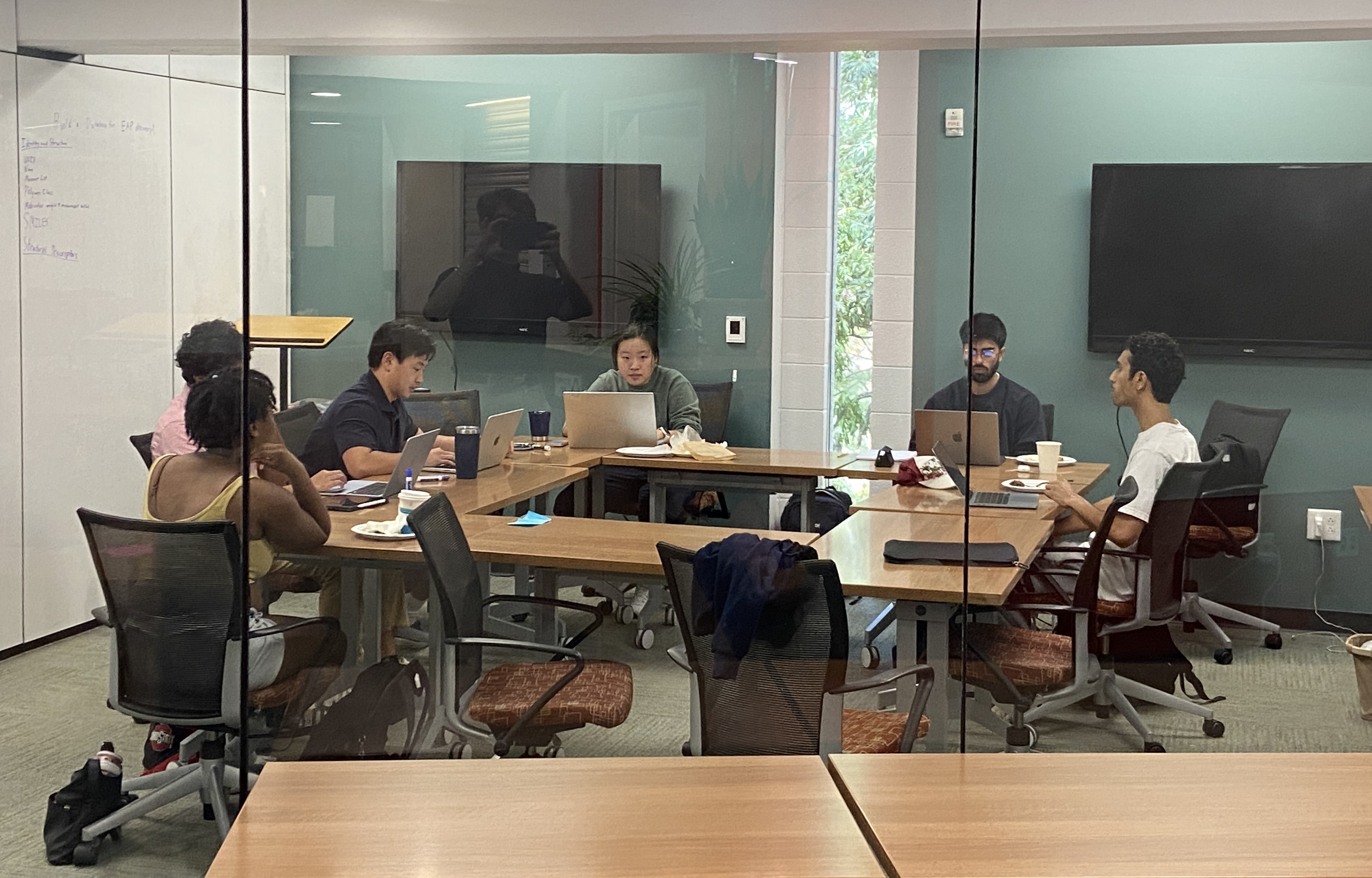
On September 11–12, 2025, Duke University proudly hosted a local site for the 3rd Annual LLM Hackathon for Applications in Materials & Chemistry. This international event connected 17 sites made up of over 1200 researchers, students and innovators across continents. The Duke Hackathon site highlighted the power of collaboration, locally and globally, in tackling scientific challenges with AI.
Organized by Defne Circi (MEMS PhD, CS Masters), Oliver You (CS Masters) and Tiffany (AI-PI Masters) Degbotse and co-sponsored by the aiM Program and the Master’s of Engineering in AI, Duke community members brought their curiosity, creativity and passion for applying Large Language Models (LLMs) to some of the biggest challenges in materials science and chemistry. Their collective expertise and collaborative spirit made the Duke-site Hackathon a huge success.
Teams, composed of members spanning disciplines, submitted videos introducing their project idea and development progress. Projects ranged from receptor-odor chemistry to polymer answer engines. The following Duke members were on Hackathon teams. Check out their video submissions.
Justice Lu (PhD Molecular Genetics). Award winner for AbtraxTech project for applications in taste/smell/analytical chemistry. SmellMap is a computational framework that integrates LLM embeddings with structure prediction to model receptor–odor relationships. See video Turning Smell from a Mystery into a Map Video
Tiffany Degbotse (Master of Engineering in AI for Product Innovation), Diya Mirji (Master of Engineering in AI), Sharmil Nanjappa (Master of Engineering in AI for Product Innovation). The team developed an application where users select a molecule composition, which a kNN model analyzes to predict biodegradability. An LLM then explains the features and prediction in plain language, suggests a plausible polymer with a similar profile and discusses its biodegradability. See video Team POSP Video
- Carol Bu (PhD Chemistry) and Roshan Gill (Master of Engineering in AI for Product Innovation). The team developed PolyNexus, an AI-powered gateway that delivers instant, citation-backed polymer insights from curated literature, enabling researchers to ask questions and receive fast and accurate answers. See video See video PolyNexus: an AI assistant that connects directly to curated polymer dataset
- Defne Circi (PhD Mechanical Engineering and Materials Science, Masters of Science Computer Science) with Mohd Zaki (Johns Hopkins), Abhijeet Gangan (UCLA), and Shashank Kushwaha (University of Illinois at Urbana-Champaign). The project MuMMIE presents a multilingual workflow and benchmark for extracting composition–property information from noisy patent texts in materials science, highlighting challenges in non-English data and evaluating model performance to advance inclusive scientific databases. See video MuMMIE: Multilingual Multimodal Materials Information Extraction Video
- Alex Oh (Master of Engineering in AI for Product Innovation). The project develops an instruction-following retrieval dataset for the chemistry domain using the ChemLit-QA dataset with nuanced passage pairs, enabling retrieval models to meet complex research needs. See video ChemLit-QA Instruction Video
Other hackathon participants included Andy Kapoor (Mechanical Engineering and Materials Science MS), Ja’Nya Breeden (Computer Science PhD ), Gaurav Law, (Master in Interdisciplinary Data Science), Arvind Kandala (Master in Interdisciplinary Data Science), and Tom Pan (PhD Computational Biology).
Huge thanks to Shuyan Zhou, Assistant Professor of Computer Science, who offered support as an LLM project consultant, and Abstrax Tech for their support of local and international projects.
The international LLM Hackathon for Applications in Materials Science & Chemistry competition is designed for hybrid teams and community development through active slack channels, mentorship from seasoned academic and industry experts, and access to shared digital resources. Submitted projects are evaluated in the international competition for prizes and continued research support.